

“Jack’s recovery and reinterpretation of Aristotle’s phantasia bouleutike is a true service to the discipline. Her analyses of individual neuropolicy cases and insightful textual criticism make The Phantastic Brain a meaningful expansion to the emerging field of neurorhetoric.” —S. Scott Graham, author of The Doctor and the Algorithm: Promise, Peril, and the Future of Health AI
“Jordynn Jack is the leading expert in neurorhetoric, and The Phantastic Brain is a timely, urgent, and important work. We occupy a kairotic moment where Jack’s exact argument and evidence could support more inclusive and rhetorically informed policy practices across multiple arenas, from education to STEM to public service instruction.” —Ashley Rose Mehlenbacher, author of On Expertise: Cultivating Character, Goodwill, and Practical Wisdom
From Sputnik-era anxieties to cursive mandates and recess, traces how neuroscience rhetoric has informed education policy and debates from the 1950s to the present.
Since 2000, US politicians have leveraged neuropolicy, or policy arguments informed by neuroscience, to influence education, from mandating cursive lessons to advocating for music and the arts. The Phantastic Brain is the first book-length analysis of neuropolicy from a rhetorical perspective. In it, Jordynn Jack examines neuropolicy from the 1950s to the present, arguing that neuropolicy works in part by promoting the act of imagining alternative futures and choosing among them: what Aristotle termed phantasia bouleutike. In this way, neuropolicy rhetoric builds audience perceptions of a nation “falling behind” and offers visions of a neuroscience-enabled future in which the brain functions as a space of possibility and growth.
Calling upon archival sources including policy reports, newspaper accounts, presidential speeches, and AI-generated brain images, Jack develops a theory and method for phantasia bouleutike and traces how neuroscience rhetoric informs debates surrounding growth mindsets, handwriting, recess, and the arts. In this rich contribution to scholarship on science rhetoric, policy rhetoric, science and technology studies, and critical neuroscience, Jack ultimately argues that we need more capacious models for educational policy that fully consider interactions of brain, child, and environment without pinning the future on individual brains and their performance.
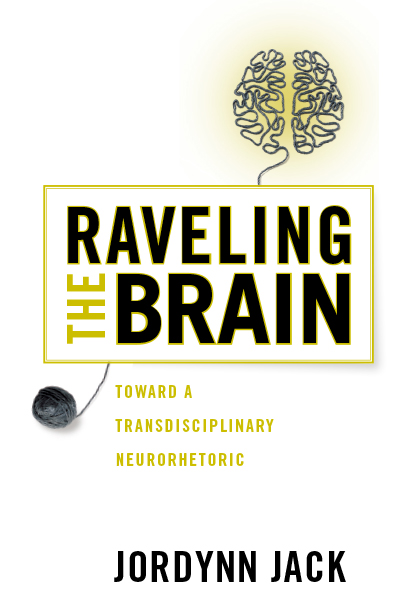
Jordynn Jack is Professor in the Department of English and Comparative Literature at the University of North Carolina at Chapel Hill. She is the author of Raveling the Brain: Toward a Transdisciplinary Neurorhetoric, Autism and Gender: From Refrigerator Mothers to Computer Geeks, and Science on the Home Front: American Women Scientists in World War II.
Contents
List of IllustrationsINTRODUCTION
CHAPTER 1 Envisioning a Nation Falling Behind: From Sputnik to the Decade of the Brain
CHAPTER 2 Visualizing Magnitude: Art, Music, and Recess
CHAPTER 3 Mediating Desire: Schools of the Future
CHAPTER 4 Picturing Concepts: Growth Mindset and Grit
CHAPTER 5 Seeing the Brain: The Ambient Visual Environment
CHAPTER 6 Imagining the Evidence: The Handwriting Debate
CONCLUSION Conjuring Future Brains
Acknowledgments
Works Cited
Index
Related Titles:
Rhetoric of Health and Medicine As/Is
Theories and Approches for the Field
Edited by Lisa Melonçon, S. Scott Graham, Jenell Johnson, John A. Lynch, and Cynthia Ryan